
You Focus on Recovery,
We’ll Focus on the Fight
We’ll Focus on the Fight






What is FELA?
The Federal Employers’ Liability Act (FELA) is a powerful federal law enacted specifically to protect railroad workers. Unlike the standard “no-fault” Workers’ Compensation that covers most Michigan employees, FELA allows you to sue the railroad directly for damages. Because the railroad industry is uniquely dangerous, FELA holds your employer to a higher standard of safety. If the railroad’s negligence played even the smallest part in your injury, you are entitled to recover full compensation—including damages for pain and suffering, which are not available under the Michigan Workers’ Compensation Act.
At Davis Law Center, we have spent over 30 years helping Metro Detroit railroaders navigate the complexities of FELA. From our office in Farmington Hills, we provide the aggressive representation needed to go up against major carriers such as CSX, Norfolk Southern, CN, and CPKC.
The hours following an injury are the most important for your claim. The Railroad is already building a case against you; let’s start building yours.
FELA is not like workers’ compensation. Instead, FELA is a “fault-based” system, meaning you must prove the railroad was at least partially negligent in causing your injury or violated the Safety Appliance Act.
Under FELA, the railroad has a “non-delegable duty” to provide you with a reasonably safe place to work. Negligence occurs when the railroad fails to meet that duty—even in the slightest way. Common examples of railroad negligence that lead to successful FELA claims include:
The Safety Appliance Act mandates that the railroad must provide safe tools and equipment as well as proper training for the use of the tools and/or equipment, and proper training for any work involved in the everyday operation of a railroad. This includes not only railroad cars but tracks, machinery, appliances, and a catchall, “other equipment.” Under this statute, the employee needs only to demonstrate that the Act was violated and that the violation contributed to his injury to recover damages. As an example, we represented a client engaged in coupling railroad cars. The cars connect via knuckles attached to a drawbar with a knuckle pin. In our case, the knuckle pin fell out, and our client injured his back while trying to keep the drawbar from falling onto his foot. We sued under the Safety Appliance Act and FELA, and the Court held the defendant railroad responsible for Plaintiff’s damages based solely on the defective knuckle pin.
Unlike Workers’ Comp, a successful FELA claim allows you to recover:
Unlike standard Michigan Workers’ Compensation, which is “no-fault,” FELA requires you to prove that the railroad was at least partially negligent. However, the “burden of proof” is much lower under FELA. If the railroad’s negligence played even a small part in your injury, you are entitled to compensation. Additionally, FELA allows you to recover damages for pain and suffering, which Workers’ Comp does not.
No. It is illegal for a railroad to terminate, harass, or discipline you for reporting an injury or filing a FELA claim. If you feel you are being intimidated by a supervisor or claims agent in the Farmington Hills or Detroit yards, contact us immediately to protect your rights.
No. This is one of the most common misconceptions. You have the absolute legal right to be treated by a doctor of your own choosing. We always recommend seeing an independent specialist to ensure your injuries are documented accurately.
You can still recover damages. FELA uses a system called “comparative negligence.” If a jury finds you were 25% at fault and the railroad was 75% at fault, you still receive 75% of the total award. In some cases—such as when the railroad violates a federal safety statute (like the Safety Appliance Act)—you may be able to recover 100% of your damages even if you played a role in the accident.
Generally, the statute of limitations for a FELA claim is three years from the date of the injury. However, for “cumulative trauma” cases (like hearing loss or repetitive motion injuries), the clock starts when you first knew or should have known that your injury was work-related. Because evidence in railyards disappears quickly, it is vital to start the process as soon as possible.
Every case is unique, but FELA damages are typically much higher than Workers’ Comp. A settlement or verdict can include:
Past and future lost wages (including lost overtime).
Medical expenses not covered by insurance.
Pain, suffering, and mental anguish.
Loss of earning capacity if you can no longer work on the railroad.
We aren’t a national “settlement mill.” We are a Farmington Hills law firm that understands the specific hazards of Michigan’s infrastructure. Whether you work out of the Rouge Yard, the Oak Yard, or anywhere along the Detroit-Chicago corridor, we know the terrain.
We represent conductors, engineers, maintenance-of-way workers, and signalmen who have suffered:
At Davis Law Center, we take the financial stress off your shoulders. We work on a contingency fee basis, meaning you pay nothing out of pocket. We only get paid when we successfully recover a settlement or verdict for you.
Call Neil Davis today at (248) 865-7740, fill out our contact form, or visit our Farmington Hills office on Northwestern Highway for a Free, Confidential Case Evaluation.
Davis Law Center: your trusted partner for railroad accident & FELA cases. Serving Detroit, Farmington Hills, Southfield, Macomb County, and all of Michigan.
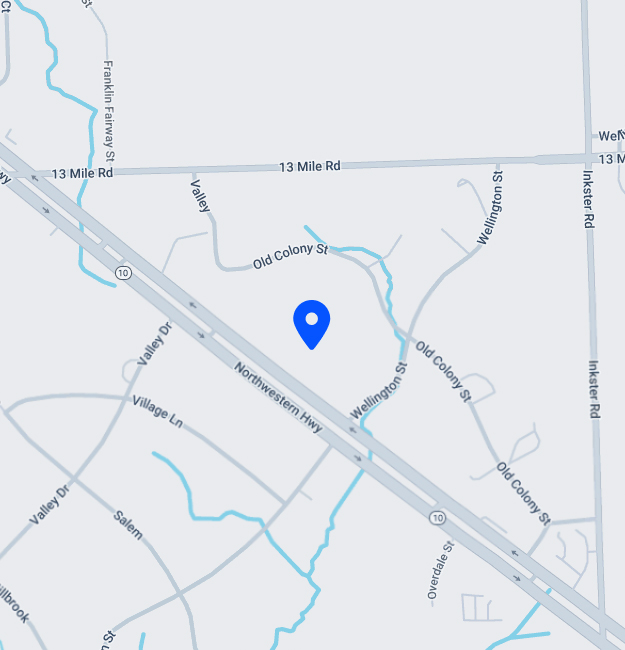
We are located in Farmington Hills, Michigan and serve clients throughout the metropolitan Detroit area, including Wayne, Oakland, Macomb, Livingston, Genesee and Washtenaw counties.


